My essays about healthy relationships with God, others, & yourself.

Category: Marriage (Page 2 of 3)

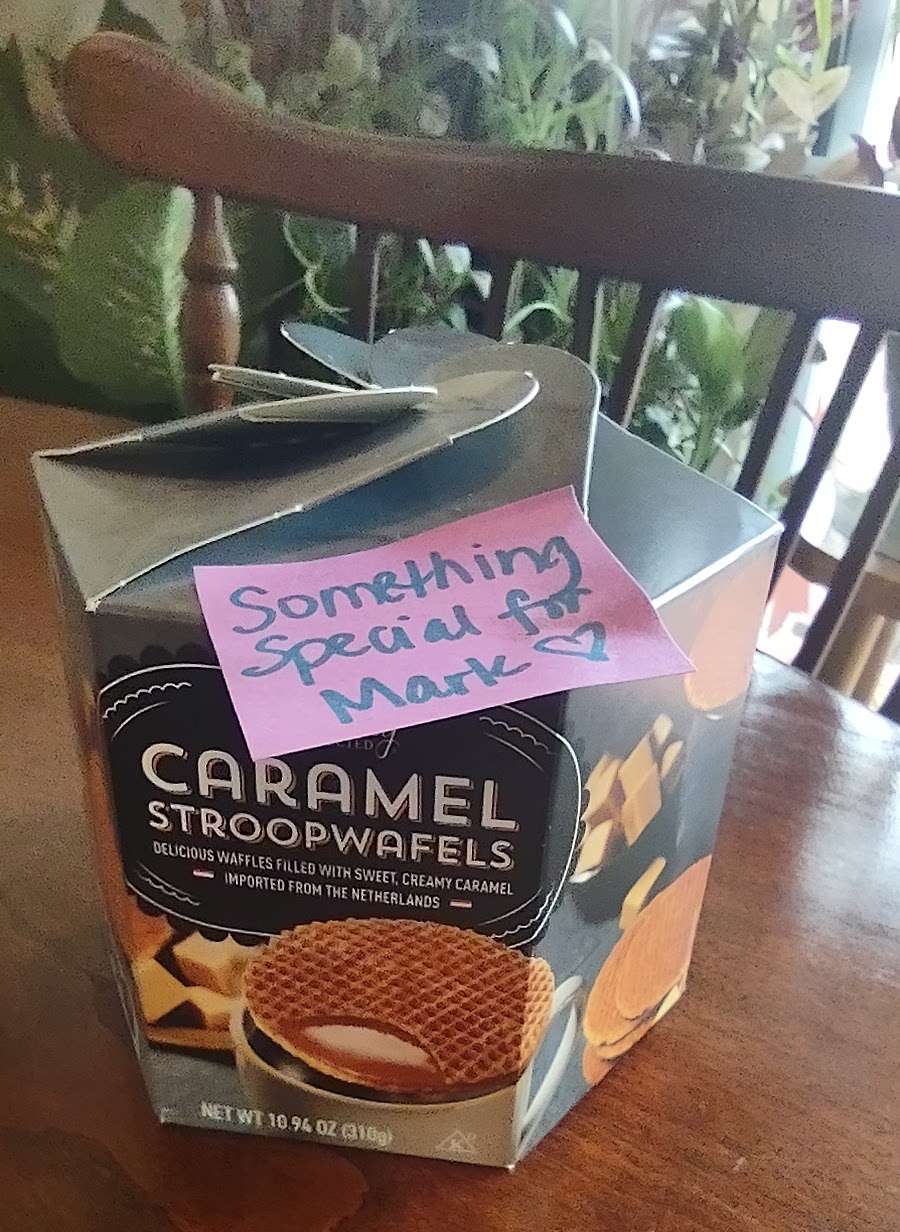
Something Special for Mark

Our life improved when we got rid of the paper grocery list on our refrigerator and instead started sharing an online *Google Doc that we always can access from our phones.  That way, when either of us might happen to be near a store, we’ll know what current things could be picked up there.  On one simple page, we have running lists for things to get at Aldi, Walmart, Hy-Vee, the Dollar Tree, Menards, etc.  Once purchased, we delete the items so the other spouse knows the items were obtained.

This has been such a blessing, preventing us from 1) being in a store trying to remember what it was that we had written down and 2) keeping us from each buying the same thing unknowingly.

One day, just as a joke, I wrote “Something Special for Mark” on the Aldi section of the list.  Always good at following directions, Cindy added to her 25-cent “rented”  cart some little treat she knew I’d enjoy.  Even though it was intended as a joke, I was surprised at how much her thoughtfulness meant to me

And I noticed something else.  Unlike the other items purchased that day, Cindy hadn’t deleted my joke from the shopping list.  Almost automatically, I quickly added “Something Special for Cindy” on the list.   And now, months later, those are the only two items that perpetually remain on our shopping list.  Now, when either of us goes to the store, we instinctively look for something thoughtful that we know the other would enjoy.

It’s just a small thing, but it makes a big difference.  A little thoughtfulness goes a long way!  I recommend you put a surprise for your spouse on your shopping list!


(*I’m sure there are shopping list apps that do the same thing as our Google Doc without having to type and erase so much.  If you have any recommendations, please put them in the comments!)

Critical Spouse Theory

My wife, Cindy, and I were talking recently about obstacles to healthy marriages. One of the things we have observed happening in marriages today is the tendency to frame marriage problems using an Oppressed / Oppressor perspective.  Cindy brilliantly coined a phrase for this which I want to elaborate on today:  “Critical Spouse Theory.”

In this view, I am the Oppressed and my spouse is my Oppressor.   This approach is destructive to marriages on several levels.

First.  Both parties will inevitably declare themselves to be “the Oppressed.”  In a world where marriage is seen primarily as a means to one’s own personal happiness and fulfillment this resonates well.  Anything that blocks one’s personal fulfillment is obviously oppression!

As I said, both the husband and the wife will consider that they are the Oppressed and their spouse is the Oppressor–and they’ll have plenty of support to back their claims;  if they hop on TikToc or YouTube, they’ll find hundreds of ex-wives or ex-husbands, reinforcing this view that they don’t need to put up with such oppression from their spouse.

Second.  This way of looking at my spouse is overly simplistic.  It lumps her into the general category of Oppressor, discounting any of her good qualities.  In this worldview, there is no such thing as “partial oppression”–it’s an all-or-nothing approach.   I cannot see any of the good because I’m focusing only on the bad.

Third.  Once I apply this negative label of “My Oppressor,” I no longer look at my spouse as the precious person I fell in love with, but now I see her as my enemy.   This identity distortion will spoil every interaction between us.  I’m not talking to a decent human being so neither do I have to behave like one.

Fourth.  I develop the belief that Oppressors can’t change.  They can’t improve.  They’re not safe to be around.  I need only to protect myself.

Fifth.   This perspective, therefore, absolves me of responsibility.   The Oppressed gets a pass on moral culpability.  I hear this all the time in the counseling office.  “I don’t have to treat him decently until he stops Oppressing me.”  And of course, the culture will reinforce this.  The Oppressor is only capable of evil and the Oppressed is exempt from moral critique.

Sixth.   Things are unlikely to change for the better.  With this mindset, the only way for my oppression to end is for me to keep away from my Oppressor.  Divorce is the likely outcome.

Seventh.  Critical Spouse Theory doesn’t offer any hope for a healthy marriage.

Avoiding the Critical Spouse Theory worldview

Most of the essays I write on Christian marriage are the antidote to Critical Spouse Theory.   Here’s some links to several of them.

1.   We must recognize that Christian marriage must never be primarily about personal happiness and self fulfillment.  That is a consumer-based, commodifying basis of marriage.  A Christian marriage is not a contract, but rather a covenant.  Marriage isn’t a perpetual honeymoon, but it is rather a crucible for character-building, where we learn to be like Christ in how we relate in the most intimate of human relationships.   I learned this from my favorite book on marriage, Gary Thomas’s “Sacred Marriage,” which I highly recommend.   Marriage ought to be the context where we learn to love, serve, apologize, forgive, experience grace and grow toward one another.

2.  We must recognize that all of us are a mix of Oppressor and Oppressed.   It’s rarely one sided.  Our marital love fails.   We all hurt the ones we love.  We all fail to fully keep the wedding vows we made.

3.  We would do well to focus on our side of the equation–becoming less of an Oppressor.  Take responsibility for what you need to change about you. We must focus less on the other person’s faults.  Jesus taught to take the log out of our own eye before obsessing over the speck in someone else’s.

4.  We must get rid of the 50-50 mindset.  I’ll automatically see myself as the Oppressed when I think that I’m unfairly getting less than my fair share.

5.  We must remember that we don’t get a pass on loving our spouse even when we may feel Oppressed.

6. We remember that people can change, and we must give them that opportunity.  We should extend to others the same opportunity for growth and change that we would want ourselves.  To declare that someone can’t change is to deny God’s ability to transform a sinner into a saint.


One final word.  I’m not saying there aren’t actual cases of abusive treatment in marriage–there are!  If you are in physical danger, call 911.  If your children are being abused, take them and get out.  Implement whatever boundaries are needed and even separation may be needed for a time while things are being sorted out.  Yes, there are exceptional cases of abusive treatment, but they are exactly that–exceptional.  Most of us just need to learn how to better respond to the ordinary challenges of marriage.

One further book recommendation.  After writing this post, I came across an excellent book that I highly recommend by Don Thomas called:  Abuse: A Biblical Perspective.  He elaborates on many of the same points I make above regarding how Critical Theory has infiltrated the church’s view about marriage, redemption, and restoration.


Not getting divorced doesn’t mean your kids aren’t being raised in a broken home

I’ve met many Christians who are determined to never get a divorce due to their biblical convictions, but I find the goal of simply not getting divorced to be extremely short-sighted.  I’m not here to make a case for or against divorce, but my point here is that there are many seemingly “intact” marriages that are so unhealthy that their kids can only be described as growing up in a broken home.


Kids thrive best in a stable, loving, secure home with a mom and a dad who love them and love each other.   A mentor of mine said decades ago that the best gift you can give your kids is to display love for your spouse.  I agree.

Here are two scenarios that in my view constitute a broken marriage.

Lack of Affection.  Over a decade ago, I wrote about the importance of affection in marriage.  My views haven’t changed.  Most marriages begin with affection, but many couples lose it along the way.  Do we who are married show our kids that marriage is a delight or do they see ours as a loveless, contractual arrangement where we parents simply co-exist?  If our wedding vows have morphed into “I will tolerate you ’till death do us part,” what would compel our kids to ever want to make wedding vows at all?   So many couples function as roommates rather than lovers, which falls short of God’s design for marriage (e.g., Song of Solomon).  Plus, affectionless marriages naturally cause worry that affection may be sought outside the marriage, raising insecurities for the whole family.  The stakes are high.  If you are in a loveless marriage, now is the time to get marriage counseling to recover that affection!  How healing it would be for your kids to witness the rekindling of your affection.

Adversarial Relationship.  The concerns expressed above rise exponentially when parents display an adversarial relationship toward one other.   Parents, to whom kids look to instill safety, stability, and security in the home, instead instill fears and insecurities when they yell, swear, insult, criticize, get defensive, withdraw, or show contempt toward their spouse in front of the kids.  Do you know that parents are by far the greatest influence on their children?  That’s why when parents model destructive ways of interacting with others, kids often follow their example.  And all this hostility in the home makes it more likely these kids will develop chronic fear, depression, and anxiety disorders.  The stakes are high.  If you are in an adversarial marriage, now is the time to get marriage counseling.   Let your kids have a front-row seat as you repent and repair your marriage, being transformed from adversaries to allies.

In summary, simply avoiding divorce is not sufficient.  If your unhealthy marriage is harming you and your kids, take the step to get marriage counseling.  If you live in Iowa, I have a great place to recommend!  My colleagues and I would love to help you!

Complaining more may improve your relationships

My in-laws will never forget the day–years ago–when I suddenly stood up after a big family gathering and declared to everyone, “You people do something I don’t like!”  Even I was shocked that I had said such a thing!  We had just finished our meal and I had been unexpectedly triggered by something.  There was no going back now, so  I continued my complaint, “I don’t like it when you Hooblers stack the dirty plates after a meal because then I have to wash both sides of every plate!  That causes me extra work, which I don’t like!”

We had the Hooblers over for dinner again today, and, as they were handing me their plates one at a time, they once again recalled my dramatic outburst that day so long ago.  We laugh about it every time!

Complaining improved my relationship with my in-laws!

But what if I had used Criticism instead of a Complaint?  Aren’t they about the same?  Not at all.  I find it helpful to make a clear distinction between Complaints and Criticisms.

Complaints are honest expressions of things we wish were different.  They primarily utilize “I” statements and their intent is simply to create awareness about what would improve things for me.  The focus is education.

Criticisms, in contrast, are harsh judgments of a person’s character.  They primarily contain “you” statements and they often utilize excessive negativity, sarcasm, and loaded questions.  Their intent is character assassination, revenge, and vindication/victimization.  Criticisms point out a person’s faults, make assumptions about motives, and frequently use the words “always” and “never.”   They often resort to blaming and shaming, finger-pointing, and scapegoating

What if I had utilized Criticism instead of Complaint at the dinner table with the Hooblers?  Imagine what different result would have occurred had I had suddenly stood up after dinner and said this:

“You people really love making my life harder, don’t you?  You’re always trying to make more work for me and you don’t even care about the fact that now I’m going to have to put in twice as much work to clean up your messes.  You never think about anyone but yourselves do you?”  Well, I’m sick and tired of you coming over here and treating me like your slave. ”

I can guarantee there would have been no laughter today had I approached them back then with harsh Criticism.  Hurt and emotional distance? Likely.  Laughter?  Not a chance.

To be fair, it’s worth noting that as far as the dishes go, using either a Complaint or a Criticism will likely produce the same result.  A Complaint would sensitize relatives on how they can be a blessing to the host.   A Criticism might keep in-laws from ever coming over for dinner again!

[Side note.  If Criticism has been the pattern in your relationship, it’s likely that your genuine Complaint may be interpreted as a Criticism.  This is because you have conditioned the other person to brace for impact.   In that case, you will have to add extra sweetness to your Complaint to make your motives clear and to avoid misinterpretation.  You’ll need to go out of your way to include positivity, prior to your Complaint, saying: “I love you so much and I want to share something with you that I think will help us get closer.”]

There is also a third option when frustrations arise:  Concealing our feelings.

Like Criticism, Concealing feelings is another poor option.  Stuffing our feelings and pretending we’re not bothered by something may seem charitable, but it’s also dishonest;  it denies reality and erodes transparency.   Wearing masks brings neither closeness nor connection.  It is much better to disclose our true feelings, which demonstrates self-respect as well as respect for others–those we care about deserve to know how their actions affect us!

So let’s neither Conceal our frustrations nor Criticize others.  Instead, let’s  Complain more for healthier relationships!


I credit learning the difference between a Complaint and a Criticism from a book by Dr. John Gottman, “The Seven Principles for Making Marriage Work.” an excellent marriage book that I recommend for couples.   How we speak to each other makes a world of difference if we want to have healthy relationships.

Scrapping the Honey-Do List

Recently I did something that has made my life much more enjoyable.  I scrapped Cindy’s Honey-Do List–permanently!  Since getting rid of it, my life has improved considerably.

For you singles reading this who may someday get married, let me explain what I’m talking about.  A Honey-Do List is a list that your spouse will make for you and leave in a prominent place for you to see.

Usually, the list will contain household projects or chores that you won’t care about whatsoever (otherwise you would have already done those things and there would be no need for a list.)  To you, most of the things on your list will seem needless, irrational, frivolous, or a waste of time and energy.  Your spouse has likely gotten tired of nagging you about these things and is hoping that putting them in list form will motivate you to action.  This will rarely occur.  And if you ever do accomplish the projects on your list, you will likely do them with much grumbling and eye-rolling.

Except for the nagging part (Cindy doesn’t nag), that’s how it’s been with me for the past 37 years of marriage.  That changed a few months ago when I discovered an easy way to scrap Cindy’s Honey-Do List and be free from its burdens.  Why didn’t I think of this sooner!

Before I scrapped them, Cindy’s Honey-Do Lists would often contain things that I considered to be a total waste of time.  Things like:

  • Paint the deck where the old paint is peeling.
  • Rake the unsightly leaves from the yard.
  • Put covers over the air conditioner unit and grill.
  • Shovel the 8 inches of snow off the driveway so the ladies’ group can get to our front door.
  • Unreasonable stuff like that

As you can see, pretty much everything on Cindy’s list was totally ridiculous.  Surely,  you can sympathize with my reluctance to comply with such frivolous tasks and can understand my incessant eye-rolling about such matters!

So how did I shake free from this oppression?  Let me tell you the story.

Late last fall another ridiculous item appeared on Cindy’s Honey-Do List–Check the gutters for leaves.  In Cindy’s “irrational” way of thinking, leaves could blow on the roof, get washed into the gutters, and clog the gutters, causing water to stop flowing down the gutters, turning to ice in the gutters, causing ice dams to form, causing water to leak through the shingles and into our house, causing untold damage and destruction.  As I said, ridiculous!

As usual, I protested in my head, appealing to logic and common sense as my reason to resist.  The tree in the front doesn’t have that many leaves and it doesn’t even hang over the roof.  We’ve never had ice dam problems in the 33 years we’ve lived here.  The risk of me falling off a ladder far surpasses the risk of having our house destroyed by a theoretical ice dam.  It’s cold outside.  And on and on my mind went, looking for any way to opt-out.

And that’s the moment when I had my epiphany about completely scrapping Cindy’s Honey-Do List.

This profound thought hit me.  What if reframed Cindy’s list from…

Things That Need to Be Done  (which, of course, we will disagree on and which I will stubbornly resist)

and instead, think of it as a list of…

Things That Would Mean A Lot To Cindy  (which no one can disagree with and which I actually find motivating)

This new viewpoint literally made a world of difference for my attitude.  I literally rushed to the garage, grabbed the ladder, set up the ladder, climbed the ladder (putting my life at risk by the way), and looked up and down the gutters (confirming my prediction that there were no leaves).  And then I climbed down and put the ladder away, and rushed inside to announce to Cindy, “Honey, you’ll be so relieved to know that there are no leaves in the gutter to be concerned about.”

Loved wife.  Big kiss.  Happy home.

What made the difference?  When I looked at her list as a list of things that need doing, it was hard to avoid questioning whether those things were actually needed or not.  It caused contention about who’s opinion was more correct and whether the things were truly needed.  It set us up for a tug of war battle.  But when I looked her list as being  measurable ways to show her love everything changed.  It was akin to identifying Cindy’s extra love languages.

Ever since that day, we’ve scrapped the Honey-Do List at our house.  The new list is on my dining room table as I write this.  At the top, it reads:  “List of Things That Would Mean A Lot To Cindy.”  I think I’ll quit blogging now and go find something to check off!

Make a list of what you love about your spouse.

Yesterday, I uncharacteristically focused on the negative. So today, I want to make up for that by going positive!

Here’s today’s assignment: Make a list of 50 things you especially love about your spouse—things you appreciate so much.  (This may take longer than yesterday’s assignment because it’s so easy to focus on what we don’t like.  It’s easy to fixate on the stubbed toe and forget the other nine toes that work perfectly well.)

Go ahead and do it now before continuing to read my post. I will too.


[Pause here until finished.]


How long did it take you to come up with 50?  Did it surprise you how easy or hard it was to come up with this list?  Did it take more time than yesterday’s list of negatives?

(By the way, unlike yesterday’s list, I recommend you DO show this list to your spouse!  It would be a blessing to you both!  Perhaps you could “pretty it up” and present it to your spouse as part of a Valentine’s Day gift!)

Now at the top of your list, I want you to add the words, “NOT BECAUSE.”  This is your NOT BECAUSE LIST.

In yesterday’s post, I talked about how agape love is an essential component in a uniquely Christian marriage.  It’s the kind of love that the Bible portrays as being unconditional.

On the list I just made about Cindy, I came up with 50 qualities that I love about her.  But please note that this use of the word “love” is not agape love, it’s more akin to “like.”  I like those things about Cindy—a lot!  But if I want to incorporate genuine agape love in my marriage to Cindy, I’ll need to show love to her…not because.

Likewise, you also need to show unconditional love to your spouse not because your spouse provides… [insert all 50 of your compliments here].  The question I want you to consider is this: if none of your spouse’s good qualities existed, would you still agape love him or her?

I’m suggesting that our loving treatment must be completely unrelated to our spouse’s current wonderfulness.  Here’s why:  most of the things we enjoy today will likely go away.  Our bodies will increasingly become older, and uglier, and eventually may even become disabled.  Our minds may not stay as sharp and may deteriorate altogether.  We may lose our abilities and capabilities.  We won’t have the energy we once had.  Our strength and stamina will likely lessen.  Our productivity will decrease and may disappear altogether.

In a Christian marriage, we pledge to love purely and unconditionally till death do us part.  If my grandfather’s love had depended on my grandmother retaining her wonderful qualities, he would have left her eighteen years earlier rather than love her until she died.  His love was not because of her loveliness, which was fading.  His love toward her was agape love.

Why must we love our spouse this way?  I can think of two reasons:

First, the Bible commands that marital love should mirror Jesus’s love.  We are to love just as He loved. This not because type of love is the kind of love Jesus showed us.  He loved us not because we qualified—in fact, we could never qualify.  His love had nothing to do with our qualities.  He was choosing to love us without conditions.  We should unconditionally love our spouse in the same way.

The other reason is the Golden Rule, which Jesus taught in Matthew 7:12.  Imagine if it was your wonderfulness that faded (and it will), wouldn’t you want your spouse to keep loving you as my grandfather did?   Therefore, we should treat our spouses the same way.

I’ve taken these last two posts to define two facets of agape love, which are really two sides of the same coin.

Nothing we might do will make him love us less  (the even though  aspect of agape love).

Nothing we might do will make him love us more  (the not because  aspect of agape love).

Let’s make that true in our own marriages!

Make a list of your spouse’s faults.

Those of you who have met me know that I, generally, have a positive outlook on life.  So what I’m about to ask you to do may sound surprising:  Make a list of 50 things that annoy or irritate you about your spouse—things you would change about your spouse if you could.

Go ahead and do it now before continuing to read my post.   I will too.


[Pause here until finished.]


How long did it take you to come up with 50?  Did it surprise you how easy or hard it was to come up with this list?

Ok, now consider the categories of the things you wrote down.   Your list likely includes…

  • Annoying habits.
  • Personality quirks.
  • Differences in personal preferences or values.
  • Sinful tendencies.
  • Physical inabilities or deficiencies.
  • Lack of knowledge and awareness.
  • Other things that wound you—whether intentional or not.

To simplify things even more, we could probably summarize them all into one simple category:  All the ways in which my spouse is not just like me!  [By the way, please don’t show this list to your spouse–that would not end well!]

Now at the top of your list I want you to add the words, “EVEN THOUGH.”    This is your EVEN THOUGH LIST.

In my previous post, I talked about how agape love is an essential component in a uniquely Christian marriage.  It’s the kind of love that the Bible portrays as being sacrificial, selfless, and unconditional.  I cited my grandfather’s steadfast love for my incapacitated grandmother as my prime model.

So if I choose to utilize agape love in my marriage to Cindy, an admittedly imperfect person, I’ll need to show my love to her…even though.

Likewise, you also need to show unconditional love to your spouse even though your spouse does such-and-such [insert all 50 of your complaints here].

Our loving treatment must be completely unrelated to our spouse’s failures, foibles, and follies.  We must love purely and unconditionally.

Why must we do this?  Because the Bible commands that marital love should mirror Jesus’s love.  We are to love just as He loved.  This even though type of love is the kind of love Jesus showed us.  He loved us in spite of us.  Imagine if Jesus listed our deficiencies—it would be way more than 50!  Yet he loved us even though.

We were his enemies—rebellious, selfish, idolatrous, prideful, distracted, self-promoting, objects of wrath—and yet he treated us lovingly anyway by dying on the cross to pay the penalty for our sins.    This is the good news, the Gospel.   We’re treated better than we deserve!

But God demonstrates his own love for us in this: While we were still sinners, Christ died for us.  Romans 5:8

He offers us his unconditional love; we only need to receive it.

But back to marriage, let’s determine to love our spouse even though.

Tomorrow I’m going to have you make another list–one that I promise will be much more fun!  But first, why don’t you go ahead and destroy this list I just had you make.  It’s served its purpose.


[Note: as I said in my last post, I’m talking about normal marriage relationships.  If there is abuse, adultery, or abandonment involved, this post should not be construed to mean you must put up with it.  In fact, the most loving thing the abused one can do for the abusing one would be to stop enabling him or her to abuse!  If this applies to you, protect yourself, get help from those you can trust, and institute whatever boundaries may be needed–with growth as the goal.]

Marriage is neither 50-50 nor 100-100.

I saw a meme on Facebook that I can’t help but comment on.   There are some things about it that really trouble me, so I want to use the meme as a springboard to make some points that I think are important for a strong Christian marriage.

First, I’ll paraphrase the meme:

Marriage isn’t 50-50.

Divorce is 50-50 where you divide everything in half.

Marriage has to be 100-100, where you give it everything you’ve got.

I think I get the overall intent of the quote:  “Don’t be half-hearted in your marriage but give it 100% effort.”  It’s certainly hard to disagree with that!  We could all use a reminder to put more effort into the things that matter!    So I agree with the spirit of the quote.

I also agree with the first phrase: “Marriage isn’t 50-50.”  Too many people enter marriage with the idea that “I’ll meet you halfway;  I’ll do my half and you do yours.”  The problem with this 50-50 perspective is that it makes the couple competitors; we’re comparing who’s putting in their fair share of effort.  And it sets up a comparison about who is working the hardest at the marriage.  The natural progression of this view results in “I’ll match your effort, but no more.  If you’re not doing your part, I’m out.”  Fairness, then, becomes the standard, and the success of the marriage hinges upon me coming out ahead, or at least we come out even.   In this view, marriage is essentially about me getting what I deserve.  So we can agree with the meme that marriage isn’t 50-50.

But what about the meme’s phrase, “Marriage has to be 100-100.”?   I disagree with this statement on multiple levels!  First of all, as I’ve blogged elsewhere, it’s impossible to give 100%  at anything — simply because we’re human.  And with marriage in particular,  Love Fails and we can’t perfectly keep our wedding vows even for a single day.   So it’s an illusion to think we can give 100%.  I’ll never get anywhere close to that.

But an even greater problem with the 100-100 model is that it takes us right back to the exact same problem we had with the 50-50 model:  I’ll match your effort.  “You do your 100 and I’ll do mine. and everything’s good.”  We’re right back in competition to see who’s putting in maximum effort.  Fairness is still the standard and getting what I deserve is still the driving motivation.

Is this what a Christian marriage should be about?  Hardly!  It’s neither an “I’ll meet you halfway” proposition nor it is an “I demand you be all-in” one.  Business partnerships may work that way, but not a Christian marriage because that’s simply not how biblical love works.  The agape love that 1 Corinthians 13 describes is a selfless, sacrificial, unconditional kind of love.  It has nothing to do with reciprocation or effort on the part of the other.  It’s loving someone regardless of what they are doing.  A Christian’s wedding vow to love until death is not a conditional contract, but rather an unconditional covenant before God that does not depend on the other’s effort.

Over the years, I’ve seen many good examples of selfless love, but the gold standard, in my view, was the love modeled by my biological grandfather, Arthur Olsen toward his wife, my grandmother Ruth.   They were married for almost 70 years, which in itself shows a tremendous amount of commitment.  But the last years became the hardest for them both when my grandmother developed Alzheimer’s at the age of 72.  For the next eighteen years, my grandfather loved her unconditionally until her death at the age of 90.

What did his unconditional love look like during that final chapter of their marriage?  For the first ten years, he took care of her at home.  During that time, he assumed more and more (and finally all) of the responsibilities in the home:  cleaning, cooking, shopping, and caring for her every need with little (and finally nothing) in return.  As her mind deteriorated, she would even fail to recognize him at times, fearfully thinking there was a strange man in the house.  Yet he patiently and tenderly reassured her that she was safe with him.  And she was.

Eventually, it became necessary for her to move into a care facility, but for the next eight years, my grandfather stayed close by her side.  Though he was required to live in a separate apartment from the nursing center, he came down to see her nearly every day, sitting with her for hours, walking with her, washing her, changing her, and feeding her lunch and supper.  He would cut up her food as needed and spoon-feed it to her.  In the final six years, she didn’t recognize him at all.  In the final year, she could no longer walk and was completely non-verbal.  She grew increasingly non-responsive, head drooping, staring blankly most of the time.  Yet he remained by her side as her faithful husband.  Amazingly, never once did he complain.

The nurses at the facility teasingly said they wanted to marry my grandfather because they saw in him what a real man and godly husband really looks like!

My grandfather took his marriage vows seriously.  It would have been an insult to my grandfather to speak of such nonsense as marriage being 50-50 or 100-100.

So what should the ratio be?

I suggest we let Jesus be our model here.  Paul, in Ephesians 5, tells husbands to “love their wives as Christ loved the church.”  The whole point of the Gospel is that we are undeserving sinners and yet, Christ loved us anyway.  We did nothing to deserve His love.  In fact, while we were still his enemies Christ died for us (Romans 5:8).  So, was it a 50-50 proposition with Jesus, where He meets us halfway?  Not a chance!  Was it 100-100 with Jesus?  Ridiculous.  With him, it was 100-0.  And if His love toward His church is the standard for us to follow in marriage, then we’ll need a new ratio from the one in the meme.

Since we can’t be perfectly Christlike on this side of heaven, I suggest the model each of us should aim for is this:

99-x   (with 99 being what you do and X being what your spouse does).

In other words, faithfully love your spouse without regard to how much he or she loves you back.  That’s selfless, sacrificial, unconditional love!


[Note: In this post, I’m talking about normal marriage relationships.  If there is abuse, adultery, or abandonment involved, this post should not be construed to mean you must put up with it.  In fact, the most loving thing the abused one can do for the abusing one would be to stop enabling him or her to abuse!  If this applies to you, protect yourself, get help from those you can trust, and institute whatever boundaries may be needed–with growth as the goal.]

You don’t have to like it to eat it.

I am perhaps one of the most qualified people to write this post.

I know some people who are very particular about what they eat.  They immediately spit out whatever they find the least bit distasteful.  That’s not me.

For some unknown reason, I’m oftentimes more interested in experiencing a new taste sensation than I am about needing to be pleased by it.  I’ve said many times, “This thing that I’m eating is very unpleasant–but oh, how interesting!  It tastes awful, but it will sure make a great story!”  I’m also known for accepting food challenges, like chugging a bottle of Tabasco, or twice winning the Blazin’ Challenge at BWW.

Anyone who knows me knows that I always strive for “the full experience.”  Adventure matters more to me than pleasurable tastes in my mouth. I like surprises and trying new things.  So at restaurants, I generally look for the most interesting thing on the menu —  the more unfamiliar or extreme the better!  Or I’ll randomly order something like “lunch #7” just to see what the waiter brings me.

When Cindy and I took our trip around the world last year to visit friends in Europe, Africa, and Asia, one of my side goals was to sample each country’s most exotic foods.  Ever had African cow udders on a stick?  How about Chinese pigeon heads (including the skull!)?  Or Myanmar’s stinky fruit ice cream?  Or fresh silkworms from the Chinese market?  What about steamed pig fallopian tubes?  Or Togolese goat head stew, including the snout, eyes, and brain?

I’ve eaten all those things and more, and the picture at the top of this post documents some of it! And with only a few exceptions I always choose to finish whatever I start to eat, regardless of how much I may or may not enjoy it.

So why am I telling you all this?

Not merely to merely entertain you, although I hope I made you smile!  Not merely to make you feel better about your own less-miserable life!  Not because I’m suggesting that you join me in my culinary escapades (I know you’re relieved to hear that!).

I share this because my peculiar attitude toward eating might actually provide somewhat of a metaphor for abundant living:  we mustn’t let the tastebuds of our lives expel everything we find unpleasant.

We mustn’t let the tastebuds of our lives expel everything we find unpleasant.

In other words, there are undesirable things we must say “yes” to.

Parenting works better this way!  Obviously, the early stages of parenting involves unpleasant realities that we must embrace!  Like it or not, new parents’ must give up their own desires for a greater good–after all, who really desires to change that poopy diaper!

Marriage works better this way!  Cindy and I were having a discussion about marriage the other day with a young couple who wanted us to identify characteristics of a strong marriage.   One was the importance of letting go of your preferences for the sake of the marriage.  In a good marriage, there is a determination that I will remain committed to you even when you don’t do all the things I find pleasant.  It’s an attitude that says, “ I don’t need you to fulfill all my desires.”

Self-care works better this way!  How ironic it is when we shun discomfort in the present and think we will be more comfortable in the future.  Discomfort is actually the pathway to comfort.  Immediate gratification keeps us from the growth and development that only comes through hard-earned exercise, healthy eating, soul care, etc.

You can change the world this way!  I get inspired by people who sacrificially give up their personal preferences on a daily basis to serve a higher calling.  Teachers, social workers, medical practitioners, military personnel, volunteers, and others, challenge me to focus on the needs of others rather than focusing so much on my own wants.  Think what kind of world we would have if no one was willing to give up their preferences to do such things for the sake of others!

Church selection works better this way!  When choosing a church, shouldn’t we look for a church that challenges us, awakens us, and confronts us where we need it?  If we choose one primarily because we are comfortable with everything (location, music, preaching, facilities, decor, etc.) might we unwittingly be limiting our own spiritual development?  The answer is yes.

We’d better not recast Christianity as a feel-good religion.  The prosperity gospel portrays Christianity as if God is most interested in our comfort and pleasure.  That is quite the opposite of what Jesus modeled and taught, in fact, he guaranteed persecution and suffering for his true followers.  Ours ought to be the religion of sacrificial love, not selfish, lazy, comfortable love.  I am impacted by contemporary stories of persecuted Christians around the world who are standing firm even while suffering for their faith.  I admire missionaries who so readily set aside western comforts and conveniences in order to be ambassadors for God in faraway places.  The Christian life was never designed to be easy or comfortable — at least on this side of heaven.  Doing hard things is part of the package, just as it was for Jesus Himself.

I’m not saying that it’s wrong to have preferences or that we should seek out the way of suffering all the time. Pleasure can be a very good thing–indeed, God has designed us with natural desires, cravings, and sensations that must have been made for our delight.  The very existence of beauty itself is an evidence of God’s creative goodness and love.  Apparently, He delights in bringing us delight.  The joys of life are little tastes of heaven and it seems right that we should embrace them when they come.

What I am saying is simply this:  We mustn’t let the tastebuds of our lives expel everything we find unpleasant.  There are undesirable things we must say “yes” to. 

In other words, “You don’t have to like it to eat it.”


In Togo, giant rats like this are a delicacy; this one actually cost $22–that’s more than the cost of a goat!  However, to us, it was no delicacy!  It tasted terrible;  One small bite was all we could stomach!  It’s one of the few things I couldn’t finish!

Majoring on the Majors — implementation!

I’ve already written two parenting blogs about the Majors and the Minors, but there is a need for one more.  The first post explained the difference between Majors and Minors.  The second post gave two illustrations of some outlandish behaviors of our girls that we declared to be Minors!

This final post will be a step-by-step guide to recalibrating your current list of Majors into one which is more useful.

Whether you are conscious of it or not, you currently govern your children by a specific list of Majors.  You likely don’t even think about the list, but it’s there.  There are certain things you choose to engage in battle over, and other things you don’t.

HOW TO IDENTIFY YOUR CURRENT LIST OF MAJORS

If I were to videotape your interactions with your kids for a whole week I could write down a pretty accurate list of your Majors.  Here’s what I would look for:

  1. Your use of commands is a dead giveaway.  When you tell them what they have to do, you’re clearly revealing things on your Majors list.
  2. Your choice of consequences is another undeniable indicator of your Majors. What things cause you either to use obvious punishments (such as groundings, taking away a phone, or sending them to their room) or to use the more subtle concealed punishments (verbal scoldings, blame-and-shame tactics, labeling, bribery, or other forms of manipulation)?
  3. Your tone of voice is a less obvious, but equally clear gauge of what you treat as a Major.  What behaviors do you raise your voice over?  Or nag about?  Or threaten regarding?  Or get sarcastic about?  These verbal cues subtly reveal your Majors.
  4. Your body language will also give it away.  Are your hands on your hips?  Are you frowning in disgust?  Does your face look cross with disapproval? Are your brows furrowed?  Are you rolling your eyes?  Is your face turning red?  Each of these wordless communications reveals that your kids have violated one of your Majors.
  5. Even how you pronounce your child’s name will reveal your list of Majors.  Do you normally speak their name sweetly? Or sharply, with a tone of disdain?  Is it said affectionately? Or does your voice’s pitch drop off at the end of their name, indicating your irritation with them?

FOUR STEPS TO RECALIBRATING YOUR MAJORS LIST

STEP ONE – Take Inventory

First, you must identify what things are on your current list of Majors.  Pay attention to the five things listed above and write down the Majors that are indicated by your own behavior toward your children.  Realize that you are naturally going to be blind to many of them because the interactions with your kids have likely become habitual.  Recruit others to help you identify what your own behavior reveals about what seems to bother you most.

STEP TWO – Eliminate 90% of Your Majors

Looking carefully at your list, ask yourself which of those issues are worth jeopardizing your relationship with your kids over. My guess is that 90% of your current Majors are issues that don’t matter nearly as much as enjoying harmony with your kids.

Keep in mind that by Majors, we’re talking about things you absolutely requirethings that are so important that you’re willing to engage in battles with your kids over them. These are demands of yours that justify having a strained relationship with your kids.

Most of the things that you’ll be crossing off of your Majors list–i.e. the Minors–are not that important.  They may feel important to you at first, because you’ve clung to them so long, but they are really only preferences. They are certainly not important enough to justify erecting a wall over them between you and your kids.  Re-read my first blog on this topic for a refresher on what factors should determine our Majors.

Your purged list of Majors should be noticeably shorter.  In fact, you might be shocked by how small your list is!  Not many issues are actually worth battling over, in fact, this process should greatly reduce the number of battles you have with your kids!

STEP THREE – Do Some Self-Reflection

This would be a good time to look at what you crossed off and ask yourself what made those things Majors for you in the past?  Was it your own impatience?  Was it your need to control?  Was it a need to win battles with little people?  Was it fear of them failing?  Was it the embarrassment of what others might think of your parenting if your kids acted imperfectly?  By asking these questions we’ll oftentimes discover that our own personal issues, fears, and insecurities have been causing many of the unneeded battles with our kids.  Maybe we never had a “problem child” but rather a “problem ego!”

STEP FOUR- Let It Go

Just like the annoyingly memorable song from Frozen, we have to learn to let go of the things we formerly considered Majors.  We will be tempted to return to the old list, harping on things that we wish were different.  Bad habits die hard, so we will have to be aware of our tendency to glare, scold, command, frown, and punish our kids over things that, in the grand scheme of things, really don’t matter nearly as much as our kids’ hearts.  We’ll have to let our preferences go unfulfilled and some of our expectations unmet.  We’ll have to bite our tongue sometimes.  We’ll often have to hide our disappointment.  For the sake of relational closeness and harmony.

STEP FIVE – Enjoy Each Other

With the number of household battles potentially reduced by 90%, you’ll have much more time and opportunity to enjoy one another!  By not sparring with them all the time perhaps you’ll start to see them as precious people with their own unique personalities, rather than your biggest disappointment.  Perhaps you’ll discover who God made them to be, how He wired them, and what matters to them.  Conversely, by not perceiving you as their constant critic or micromanager, they might also gain an interest in getting to know you, your heart, and what matters to you.  Influence flows from relational harmony and mutual respect, and as I’ve blogged about before, influence is a much better parental strategy than control.

CONSIDERATIONS FOR COUPLES

I’ve written the above from the standpoint of a single parent, relating to a single child.  But what about couples?  What if their lists of Majors are not exactly the same?  Three thoughts.

  • Everything above still applies to married parents.  Most of your interactions with your children happen one-on-one, between one parent and a child during the course of the day.  If you improve your personal relationship with each of your kids, reducing the battles you have with them, the whole family benefits.
  • There certainly will be areas where the parents will have to agree on household rules, i.e. acceptable expectations for children no matter which parent is present.  Wise couples will have conversations about what rules are worth battling with kids over and which can be let go of.  When agreement can’t be reached, commit it to prayer and consult with others who may offer insight.  Be intentional, not hasty, when possible.
  • Sometimes a decision needs to be made without reaching parental consensus.  Keep in mind that, scripturally, the husband is ultimately held responsible in the eyes of God for the well-being of his family, and that his leadership is to flow out of his own sacrificial love for his wife and children.

FLEXIBILITY IS THE KEY

  • The list of Majors will change somewhat over time and most household rules should remain flexible.  Always be open to reasonable feedback from any household member.  Ultimately, the parents are in charge, but everyone’s input should be valued and considered.  As family dynamics change and as kids grow older the expectations should also change accordingly.
  • Adjust rules according to the current needs of the moment.  For example, when the baby isn’t sleeping, everyone can be loud.  Or when a tidy mom is on a trip, dad and the kids shouldn’t have to keep the house immaculate–until just before she returns!  Make sure the rules in force always serve a useful purpose and are not arbitrary.
« Older posts Newer posts »

© 2026 markforstrom.com

Theme by Anders NorenUp ↑