My essays about healthy relationships with God, others, & yourself.

Category: Christian Perspective (Page 4 of 5)

Influence Optimizer #4: Verbalize Values

I once blogged about the importance of parental influence and mentioned five things that can increase it.  In the past three posts, this post, and the following post I elaborate on what I call the Five Optimizers of Influence.  While nothing guarantees that our kids will make wise choices, my 31 years of youth ministry taught me that parents who become proficient in these five areas will have maximum impact on their kids.

1. Model authenticity.

2. Avoid relational walls.

3. Build relational bridges (cultivate trust).


4. Verbalize values.

Many things are more caught than taught, but some things simply need to be taught.

Scripture gives the Israelites this instruction: “And these words that I command you today shall be on your heart. You shall teach them diligently to your children, and shall talk of them when you sit in your house, and when you walk by the way, and when you lie down, and when you rise…You shall write them on the doorposts of your house and on your gates” (Deuteronomy 6:6-7 & 9; emphasis mine).

It is clear that God expects us to proactively provide spiritual nurturing and instruction to our children; it’s our duty as parents to pass on to our children a legacy of faith.  Transferring our faith to the next generation involves living it authentically before them (as mentioned in the first post of this series) as well as instructing them accurately.

This spiritual instruction includes not only telling them what we believe but–in light of today’s accessibility to alternate worldviews–it’s equally important to explain why we believe as we do and why we reject other views.  We must show that our faith holds up to scrutiny when compared to other belief systems; therefore, we can’t afford to espouse a blind faith that comes across as having our heads in the sand!

Parents who don’t feel confident answering tough questions about spirituality have many great resources available to help supplement their spiritual instruction. The church can certainly help with this, as can worldview training organizations, such as Summit.org and podcasts, such as Sean McDowell. and Cross Examined.

Besides theological instruction, parents also need to thoroughly teach our kids about the culture in which we live.  This is a world that bombards our kids with a million false ideas, distorted perspectives, and flat-out lies.  Incessantly.  Aggressively.  Relentlessly.

There’s a tension here.  On the one hand, wise parents will limit how much exposure impressionable kids ought to have to the world.  This applies to school options as well as the culture at large.  The internet contains more misinformation than information–by a long shot!  Giving a susceptible kid an unprotected cell phone seems as reckless as inviting a cult leader or child predator into our child’s bedroom.

On the other hand, completely protecting our kids from the world’s values is naïve and unsustainable.  Parental attentiveness is key–being aware of our kids’ vulnerabilities and capabilities to discern truth from error.

In any case, parents must take care to verbalize our beliefs on all sorts of topics.  We must provide a running commentary on what our kids are seeing, hearing, learning, and reading, otherwise our silence effectively hands over the microphone to our culture.

C.S. Lewis famously said, “The most dangerous ideas in a society are not the ones being argued, but the ones that are assumed.”  This is so true.  We need to be attentive to the assumptions that our kids are being immersed in. 

Fortunately, our culture doesn’t hide its views, giving us plenty of faulty assumptions to talk to our kids about!  If you wonder where to look, you can start with the 6 o’clock news, or Superbowl commercials, or game shows, or video games, or blockbuster movies.  All of them provide volumes of values to talk about.  Every day our kids are being taught specific views about politics, morality, definitions of family, sexuality, human dignity, justice, success, suffering, etc.  Weigh in on those topics!  Talk about them!  Kids can’t consider our point of view on things if we never discuss them.  (As a bonus, by viewing our culture mindfully, we may discover how some of our culture’s assumptions have subtly tainted our own thinking!)

But we can’t just be “reactive” to our culture.  In many cases, we need to get in the “first word” so the world’s distorted views are seen in proper context from the get-go.  For example, it was important to me to be that we be the ones to inform our daughters about human sexuality and reproduction–in the context of these subjects being beautiful designs of God which are to be enjoyed only within marriage.  I didn’t want their first awareness of these important topics to come from Youtube or from the mouth of a “values-free” 5th-grade health teacher.

To be sure, in this digital world, many of these conversations will come earlier than we would have wished, and some will be admittedly awkward.  Let that not be an excuse for you to abdicate your parental responsibility of truth-telling.

Finally, it must be said that as much as we may wish to determine our kids’ values this is beyond our control.  Our goal is influence, not coercion. Ultimately, our kids will need to decide for themselves what they will believe about God, themselves, and the world they live in.  Our parental job is to expose them to truth, teach them what we have come to believe and why, etc, but we’ll be wise not to try to force them to believe any of it.  Faith must be chosen, just as love must.  We must be careful to avoid pressure or manipulation.  To prevent this, let’s allow them space to grapple with truth, wrestle with doubts, and ask us hard questions whenever they want.

Hopefully, this post has encouraged you to have serious conversations with your kids about the things that really matter.  If you don’t, someone else will!

Tomorrow I will end this series by elaborating on Influence Optimizer #5!

Influence Optimizer #3: Build Relational Bridges (Cultivate Trust)

I once blogged about the importance of parental influence and mentioned five things that can increase it.  In the past two posts, this post, and the following two posts I elaborate on what I call the Five Optimizers of Influence.  While nothing guarantees that our kids will make wise choices, my 31 years of youth ministry taught me that parents who become proficient in these five areas will have maximum impact on their kids.

1. Model authenticity.

2. Avoid relational walls.

3. Build relational bridges (cultivate trust).

Picture two little boys at the doctor’s office getting their shots, not understanding why their parents would allow the nurse to inflict such pain.  Boy #1 sees himself as a victim; his parents have betrayed him and he acts out in rage against them, madder than a hornet! Boy #2 sees things differently.  He is confused about why his parents have allowed him to experience such pain, but he has learned that they care for him deeply and would want only the very best for him.  He knows that they would never willfully harm him.  He is sad, but not mad.

Trust makes all the difference.

Convincing our kids that we are for them and not against them helps us influence them positively.  The old adage is universally true: “Until they know that you care they won’t care what you know.”  Whatever wisdom we may wish to impart will likely be rejected if they see themselves as victims.  They must feel safe and secure with us.

You may be realizing that today’s post is essentially the inverse of yesterday’s.

  • Yesterday I mentioned several things not to do [which build relational walls], creating feelings of victimization.
  • Today let’s look at several things we can do [which build relational bridges], cultivating trust.

Love. Convince them that you love them, truly love them.  It may help to figure out what their primary love languages are.  It’s easy to think we’re delivering a hefty dose of love, but it may be on our terms and sometimes we may miss it completely. If we give them Gifts when their love language is Time they may come away feeling unloved and abandoned.  Or if we give them Acts of Service when their love language is Words of Affirmation we may have left them feeling unloved and unrecognized.  Smothering a child with hugs who doesn’t have the love language of Touch may make them feel you’ve violated their personal space.  As I like to say, “Be a student of your student” and find out what makes them feel love from you.

Safety.  Make them feel safe and secure around you, and convince them that your goal is their well being.  Be careful about sarcasm, silly labels, nicknames, and joking around as these may affect their developing self-concept.  Be their protector and provider.  Be consistent.

Empathy.  When they hurt we should hurt with them.  This may sometimes require us to set aside our adult perspective and enter the world of our children in order to feel their pain.  We may even have to suspend our rational judgments for the greater good of connecting to their hearts.  Instead of “I told you that if you didn’t feed that guinea pig he would die” we should say, “It’s so sad that you can’t play with Patches anymore.  It hurts to lose a buddy like that doesn’t it?  I care that you’re hurting right now.”

Availability. You must be present to win!  Too many parents are so busy “adulting” that time with their kids gets pushed out of the way. I remember hearing Dr. Dobson years ago say that “Quality time is an accident that happens during Quantity time.”  Those words proved true in my own parenting.  Wise parents make their kids a priority in their schedules.  Family vacations, “daddy dates,” family game nights, sleeping in a tent in the backyard, etc. are all examples of ways to show your kids that being with them is important to you.  And in the process, you just might learn what’s important to them.  Be fully present with them by having these be times where everyone turns off their phones.

Respect.  I’ve blogged a lot over the years about the importance of respect, so I won’t elaborate much here.  People feel disrespected when they are being commanded a lot.  They feel voiceless when they aren’t allowed to express frustration. They feel manipulated when they are pressured to be at their best all the time. Respecting parents are prone to believe their kids and believe in them as well.

Fairness.  Parents are wise if they only set rules that are necessary, majoring on the majors.  When rules are broken, they are careful to implement natural consequences which promote learning rather than using arbitrary punishments to simply inflict pain or get even.  They avoid making hasty decisions that might seem impulsive and unfair.

Each of these components will make kids feel valued, likely resulting in greater parental influence in their lives.

Next, I will elaborate on Influence Optimizer #4!

Influence Optimizer #2: Avoid Relational Walls

I once blogged about the importance of parental influence and mentioned five things that can increase it.  In my previous post, this post, and the following three posts, I elaborate on what I call the Five Optimizers of Influence.  While nothing guarantees that our kids will make wise choices, my 31 years of youth ministry taught me that parents who become proficient in these five areas will have maximum impact on their kids.

1. Model authenticity.

2. Avoid relational walls.

Adversarial relationships between our kids and us will only cause them to resent us, which will influence them in the exact opposite direction that we intend for them. Exasperating our children is not only unbiblical (Ephesians 6:4), but it also creates bitterness in them, diminishing any positive influence we might have had.  It only makes them feel like victims.

Here are ten things that will make your kids feel like victims, ensuring that you have little–if any–positive influence on them:

  • Major on the minors.  Harp on things that really don’t matter and ignore those that really do.
  • Be unfair, inconsistent, and unreasonable in what you require of them.
  • Make decisions that will affect kids without soliciting their input or explaining why the decision was made.  Say “Because I said so!” a lot.
  • If you ask them questions at all, make sure they feel interrogated, and begin all your questions with the word, “Why.”
  • Be sure you let them know how they are such a disappointment to you.  Use creative labels for them like “stupid,” “lazy,” “brat,” and “worthless.”
  • Treat children like property instead of people, making them feel unworthy, unheard, and unwanted.  Don’t let them make their own decisions.
  • Never admit you might be wrong.  Never show weakness.  Never apologize.
  • Be easily offended, quick-tempered, unpredictable, and volatile.  Don’t let them see you smile. Make them fear you.
  • Make discipline decisions impulsively, in the heat of the moment, when you’re not thinking objectively.  Be as punitive as possible.  Show no mercy.
  • Let the busyness of life keep you from quality family time.  Work excessively.  Don’t plan family fun.  Don’t go on dates with your kids.  Don’t read to them.  Let them put themselves to bed.  Be sure not to spend any one on one time with them.

Foolish parents will do the things on this list without giving thought to the relational walls they are building between them and their kids.  How much better it is to build relational bridges by doing exactly the opposite of each thing on that list!

As mentioned previously, there are no guarantees.  Some kids will resent their parents no matter what we do; they themselves may create walls of relational separation.  Even so, let’s make it our goal that any walls that exist are caused by their sin, not ours.  And let’s pour our energy into taking down walls and building bridges to their hearts whenever possible.  That will maximize our influence on them.

Next, I will elaborate on the Influence Optimizer #3: !

Influence Optimizer #1: Model Authenticity

I once blogged about the importance of parental influence and mentioned five things that can increase it.  In this post and the following four posts I elaborate on what I call the Five Optimizers of Influence.  While nothing guarantees that our kids will make wise choices, my 31 years of youth ministry taught me that parents who become proficient in these five areas will have maximum impact on their kids.

1. Model authenticity.

“It’s more caught than taught,” is more than a cliché; it is an axiom of life.  In my experience, the primary way we influence others involves how others see us living our own lives. For good or for ill, our lives are examples that will shape the lives of others.  People are watching and being shaped by what they see in us.  But as they look at our lives there are two things they might observe: Hypocrisy or Authenticity. Both are highly influential, but they exert influence in opposite directions.

Hypocrisy:  “Do as I say.”

We all know how damaging hypocrisy can be.  Think of people with double standards, charlatans, and Christian celebrities caught covering up their vices–not having  practiced what they’ve preached.  Hypocrites influence people toward cynicism, skepticism, or all-out resistance.  Two-faced people are a primary reason people walk away from their values-of-origin, their families, and the church. So if we aim to influence others positively, it’s important that we pay attention to when our words don’t match our actions.

But aren’t we all hypocrites?  Yes we are.  All of us.

Then what hope is there for positively influencing others? The good news is that we can be authentic hypocrites!  We can own our hypocrisy, show remorse for our double standards, and seek to correct our inconsistencies. In a wonderful and ironical way, when others see us respond humbly to our imperfections it switches our influence from negative to positive!  Nowhere is this more readily seen than with our children.

Authenticity:  “Do as I do.”

I want to spend the bulk of this essay describing practical ways we can model authenticity with our children (and others who are watching) in order to have a positive influence.

  • If you want them to learn honesty and integrity, don’t let them see you calling in sick to work as you head out to the golf course.
  • If resisting temptation and finishing well is important to you, model how you incorporate accountability in your life.
  • If you want them to have a godly perspective on marriage, model a godly marriage by showing affection, love and respect to your spouse!
  • If you want them to have a close walk with God, don’t simply make them “do devotions;”  it’s far better to share with them scriptures that you are finding meaningful and share how God is shaping you through your devotional times.
  • If you want them to be more willing to do chores, model the joy of serving your family.
  • If you want them to be generous and compassionate, model the joy of sacrificial giving, including them in opportunities involving generosity.
  • If you want them to avoid self-medicating, show them your attentiveness to restraining your own vulnerabilities in this area (substances, social media, video games, materialism).
  • If you don’t want your kids to be lazy, show them what a good work ethic looks like and share how you find value in a job well done.
  • If you want them to “redeem the time” make sure you aren’t wasting time that should be spent more constructively.
  • If attending church is important to you, show that it’s a priority to you by your regular attendance and by not giving in to a coach’s demands for Sunday travel.
  • If your kids have trouble listening, make listening to them a priority.
  • If you want them to learn emotional regulation, control your anger and watch the words you say and the way you say them.
  • If you want them to treat people with respect, let them see you treating others with respect, even those with whom you disagree.
  • If you want them to exercise or be healthy, show that this is something you are attentive to as well.
  • If you want them to own their mistakes, own your own and be quick to apologize to them when you mistreat them.
  • When you blow it in any of these areas, readily admit it and show your determination to grow and change.

This is by far the most important influencer of them all.  But the other four are important as well. I now encourage you to consider the other four of them, starting with Influence Optimizer #2.

What I DON’T pray for my kids

I don’t pray for my kids every day, but when I do, there are a lot more things that I don’t pray for than I do.  

In fact, there are really only three things I do consistently pray for, succinctly summed up in nine keywords.  These are the things — in my view — that matter infinitely more than anything else.

I pray that my kids will:

Know God Accurately

Love God Wholeheartedly

Represent God Authentically

With regard to Knowing God Accurately, I’m asking that my kids will have a real encounter the Creator of the Universe and increasingly understand who He is.  I want their beliefs to correspond to the actual qualities of God, not an understanding skewed by human thinking.  I want them to more fully comprehend His omnipotence, omniscience, sovereignty, justice, holiness, mercy, love, compassion, and grace. 

By Loving God Wholeheartedly I’m asking that my kids would increasingly love God for who He is and continuously turn every part of their lives over to Him as Lord.  Loving God involves more than feelings, it’s a commitment to align their wills with His, surrender themselves to His service, and delightfully obey what He says — regardless of the cost.

In Representing God Authentically, I’m asking that my kids will increasingly become more like Jesus, humbly bear much fruit, and love others — being God’s ambassadors wherever He places them. 

These nine words sum up what matters most to me as a praying parent.  What more could I want but for these prayers to be answered?  That’s why I don’t spend much time praying for the typical things:  success, health, prosperity, finances, careers, or a spouse.  Besides, most of these things will fall into place anyway if these “top three” prayers are answered.

(I pray these same three things for myself, Cindy and others too!)

Btw, here’s what I pray for my kids’ dad — I always pray that I would shepherd, serve, and cherish them more and more…yet hold them looser and looser.

How ESPN has improved my prayer life.

Private prayer is something that I am determined to make a priority in my life.  I’ve blogged before about how I organize my prayer life but I’ve never blogged about finding the right environment for prayer.

We know from scripture that Jesus often withdrew to “lonely places” to pray and he also taught the concept of finding a “prayer closet” in which to get alone with God.  Over the years I’ve found various prayer closets that worked well, but I want to share about one that I’ve found especially helpful over the past year.

I love to run on treadmills at the iGym, but it with my busy schedule it’s hard to justify much time for that.  The thought occurred to me that if I could learn to pray while running I’d be doing two really good things at the same time.  Redeeming the time!

So, more days than not, after some time in the Word I’ve started driving to the gym for my prayer time.  It was a admittedly a bit distracting at first, but over time I’ve learned to block everything out around me and focus completely on my conversations with God.    As you would expect, I select the treadmill which is under the ESPN TV screen (which doesn’t tempt me to look up in the least!)  I also put on noise cancelling ear protectors to block out all the gym noise.  Then I put my phone on “airplane mode,” and set it up on the tray with my prayer app open (described previously), and then launch into a focused session of prayer.

My goal is to meditate through my prayer list while running as fast as I reasonably can — without losing concentration.  If I start to think about my running, I slow down.  Over time my treadmill has become my sacred space.   Here I’ve lifted up the needs of others while also receiving joy, guidance, conviction, inspiration and even brokenness. One day my spirit was so troubled by circumstances that it took me 10 miles to calm my restless heart!   As strange as it may seem, my treadmill has truly has transformed into a sanctuary.

And here’s an extra bonus:  I never get sleepy when I pray!

I share all this not to recruit anyone to pray in a gym but rather to encourage each of you to find your own private place — wherever that might

Influence is the Answer!


In my last post, I talked about the false security of relying on parental control as a way to keep our teenage kids safe and well behaved.

Today we’re going to consider a far more important parental pursuit:  PARENTAL INFLUENCE.   First let’s define it.

influence

[in-floo-uh ns]  verb (used with object), influenced, influencing.
1. to cause someone to change a behavior, belief, or opinion  
2. to cause something to be changed. 
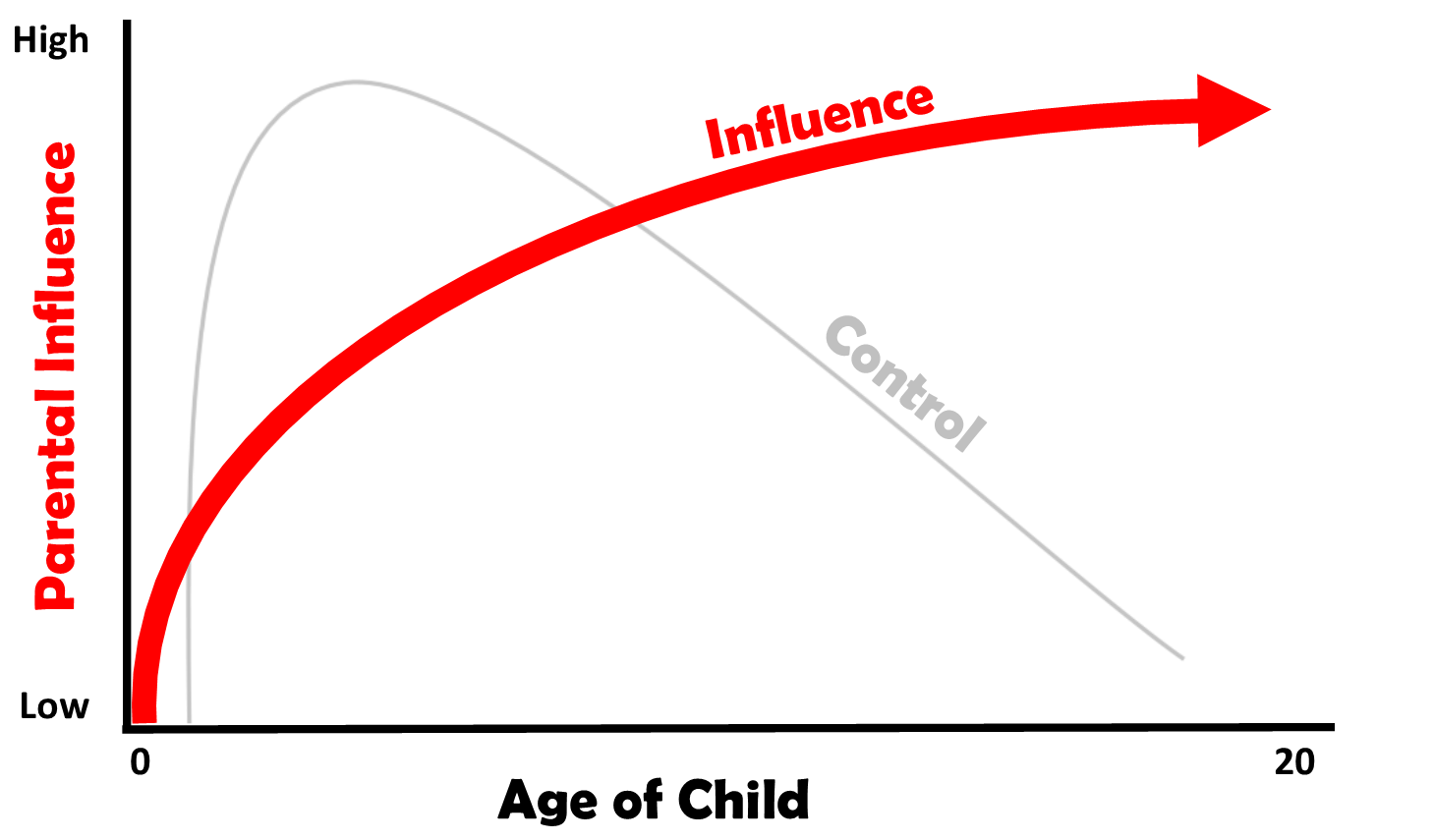
As mentioned in my first post, parental control needs to decrease during the teen years to prepare them for life out of the nest. Wise parents must shift their focus toward increasing their influence during those same years.  The graph might look like this.
Four observations.
  • Influence is a powerful force, for good or for bad.
  • Influence begins the day your child is born and can last a lifetime.
  • Studies prove that parents are the primary influencers of children — by a long shot!
  • Secondary influencers will be anyone or anything that captures your child’s mind and heart.
So what can parents do to be positive influencers of their children?
I recently did some brainstorming with a group of grown children about positive ways their parents influenced them and here are Five Optimizers of Influence we came up with.

1. Model Authenticity. Managing your own life and character well is of critical importance.  Character and values are more caught than taught.

2. Avoid Relational Walls.  Fostering a mutually respectful relationship with your kids will give them reason to follow you.
3. Build Relational Bridges (cultivate trust).  Convincing them that they are important to you, that they safe around you, and that your goal is their well being is a solid foundation for influencing them.
4. Verbalize Values.  Kids can’t process things we neglect to talk about.  The world will inform them about everything we don’t.  We need to get in the “first word” to give them context and perspective on what matters to us and reasonably protect them from destructive voices.
5. Emancipate Strategically.  Typically, parents and teens battle over kids’ emerging desires for independence.  Instead, let’s work with our kids to prepare them for living on their own.  As I’ve blogged about before, our goal is to raise adults, not kids.
By the way, most of these work with influencing anyone you care about, not just your children!
I encourage you to read all five of the essays on these topics.  I suggest you start with the most important: Influence Optimizer #1:  Model Authenticity.

An Apology…

sign-1719892_1280

An apology, if genuine, is one of the most powerful forces on earth.  It can mend fractured relationships, can instantly heal decades-old wounds, can reunite families, can stop wars, can keep a teen from running away.  We need more of them.

An apology is rarely made these days.  People dig in their heels and won’t admit they were wrong.  Look at our political climate recently.  So much abusive mudslinging and devaluing of people, yet I can rarely recall a truly heartfelt apology.  Most are owed but never given.  So much pain inflicted.

An apology requires humility.

An apology is always a good idea.  When you sense tension in a relationship, apologize for whatever you may have done to contribute to it.  Even if you think the other person was mostly to blame and you had little culpability, take the first step and apologize for your part anyway.  When in doubt, apologize.  This principle will serve you well.

An apology must take full responsibility for one’s actions.  Avoid flimsy, fake, vague apologies such as, “I’m sorry you were offended by my words.”  Or, “I didn’t communicate as well as I might have.” A good apology bares one’s soul and exposes the real offense with no sugar-coating.  “When I slammed the door in your face I was treating you with complete disrespect.  That was wrong of me.  You deserve better than that and I am ashamed of how this must have made you feel.  I am truly sorry, will you forgive me?”

An apology makes no excuses like “I wasn’t in a good frame of mind” or “I spoke out of frustration.”

An apology must be clear.  I should state what I did wrong and demonstrate that I understand the damage I did to the other.  It requires a spirit of brokenness.

An apology removes bricks from the relational walls that separate us.  And builds bridges instead.

An apology coming from an authority (parent, government leader, etc) is not a sign of weakness, but rather a sign of strength.  The impact of such an apology will actually garner respect and your children or constituents will follow you with more loyalty than if you tried to cover up your obvious misdeeds.  Children whose parents are in the habit of apologizing for their errors will grow up taking responsibility for their own blunders.

An apology is meaningless if done out of obligation.

An apology should be freely given, but never demanded.  To tell someone, “You owe me an apology” doesn’t fix anything.  It simply puts the other person under obligation.  The apology that may follow will be forced, with no certainty that it was genuine.  I some cases it may be useful to let the other person know how their actions hurt you–then it would be up to them to apologize, or not apologize.  But be careful here:  if you tell them how they hurt you be sure you’re doing it for their benefit, not as a way to attack them or play the part of “victim” to garner sympathy.  Those motives describe revenge and manipulation.  Unless we are convinced it would help them grow, I think it’s usually best not to elaborate on how they’ve hurt us, but rather focus on loving them in spite of how they treated us.

An apology that’s not given by another doesn’t give you permission to mistreat that person back.  It is possible to forgive someone who won’t apologize, in fact, you must.  Forgiveness is you canceling their debt, even if they don’t deserve it.  Just like what God did for you. You’ll live in freedom if you practice forgiveness towards those who don’t deserve it.  You’ll live in bondage if you live in unforgiveness, waiting for an apology that might never be given. As the adage says, “Unforgiveness is the poison we drink hoping the other person will die.”

An apology should not be forced upon children, as in “You owe your brother an apology.”  Parents’ response to injustice should be justice not empty words.

An apology should be made in public if the offense was made in public.  This kind of apology is especially powerful.  I saw a vivid example of this on a youth event once.  Both parties apologized publicly for the disrespect they had each publicly shown the other.  It was a profound moment and the tension in the room melted immediately into harmony.  I will never forget that moment.

An apology must be followed up with changes in how you treat the person.  If your subsequent actions negate your words then your words will mean nothing.  When someone can’t believe the words that proceed from your mouth then you have little left.

An apology should be done as soon as is prudent when you realize you’ve wounded someone.  “Don’t let the sun go down on your anger” is generally true.  God’s advice is prudent — you’ll both sleep better.

A delayed apology is the same as no apology, just as delayed obedience is disobedience.

An apology ought to be made as frequently as you mess up — daily or even more than once a day.  I suspect living a life of quick apologies will ultimately result in having less need to apologize.

An apology, if genuine, is one of the most powerful forces on earth.  It can mend fractured relationships, can instantly heal decades-old wounds, can reunite families, can stop wars, can keep a teen from running away. We need more of them.

The surprising lesson I learned from Lexi’s trip to Italy.

Lexi in ItalyOver Spring Break Lexi went to Northern Italy with the UNI Wind Symphony.   She had a wonderful time playing the saxophone which she loves, getting to know her bandmates, and enjoying a new part of the world she’d never seen.
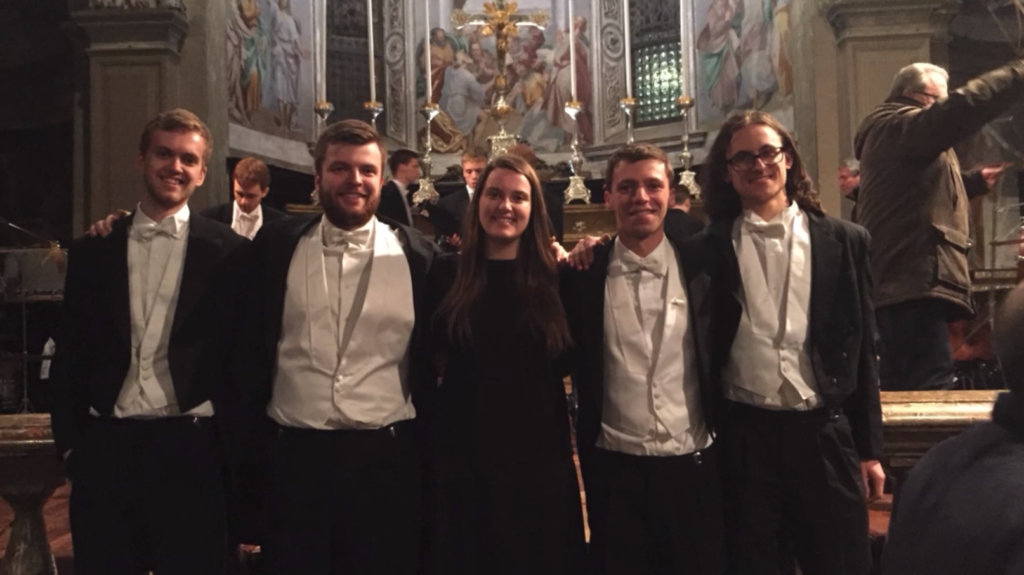

Her social role within the band quickly became that of a cheerleader.  Whenever enthusiasm would wane or boredom would creep in Lexi would pipe up, “Guys, guess what!  WE’RE in ITALY!  Aren’t you EXCITED!!” and that would return everyone’s focus to the amazing reality of their situation.

Lexi was simply reminding her friends of a truth that they already knew but had lost sight of.  Any instances of boredom or lackluster attitudes were merely the result of forgetting what an awesome place they were in.  Her animated reminders brought them back to reality and quickly helped them regain their excitement.

I think we need a similar reminder when it comes to our relationship to God.  It’s easy for our devotional life to become mundane and boring.  Why?  Because just like Lexi’s bandmates we’ve forgotten the amazing reality of our situation and we need to be reminded of what’s true.

“Guys, guess what!  WE’RE INVITED TO HAVE A PRIVATE, FACE-T0-FACE MEETING EACH DAY WITH THE CREATOR OF THE ENTIRE UNIVERSE!! HE WANTS TO SPEND TIME WITH YOU.  Aren’t you EXCITED!”

I’ve been contemplating this ever since Lexi shared about her trip and it has surprisingly transformed my approach to God.

What if I actually started living out what I know to be true?  What if I started to view spending time with God in the same way I would if I was being invited to have breakfast with a celebrity?  Would I hit the snooze button five more times if a head of state was waiting for me at my breakfast table?  Wouldn’t I go to bed early the night before if I had a breakfast appointment with a famous person, and if I were to wake up in the night wouldn’t I be counting the hours?  Wouldn’t I be excited when my alarm went off, no matter how early it was?  Wouldn’t sluggishness and boredom be unthinkable?  Wouldn’t I view my time with this celebrity as a humbling privilege rather than a chore?

By reflecting on such questions over the past months I can honestly say that I have enjoyed my early morning times with God more than ever before.  There have been many mornings when I have bounded out of bed to spend some quality time getting to know God deeper through His Word and prayer.

But it’s easy to forget what’s true.

And so just as Lexi’s enthusiasm reminded her bandmates of what they knew to be true, may this blog post remind you and me of what a privilege it is to be invited to meet each day with the Creator of the universe.

Lexi italy


Why I believe in “Intelligent Faith.”

IFC newlogo w boxOne of the saddest things is to see people blindly embracing belief systems without any supporting evidence.  God gave us minds to use and to not do so would be about as ridiculous as a person with good eyes living with blindfolds on.  To not use what God gives would be a waste of His good gifts.

But some would argue — as I did in my satirical April Fools joke yesterday –that faith and reason are incompatible.  As if certain things are matters of faith, whereas other things belong to the realm of reason.  I want to challenge that argument.  I would assert that faith and reason need to work together.

But first I need to define what I’m talking about when I use the term faith.  Many skeptics think blind faith is the only kind of faith.  Blind Faith is believing something without any rational evidence, such as believing that the moon is made of cheese.

I agree with the skeptics that this kind of faith is an unfortunate waste of grey matter.

But I’m going to suggest there is another kind of faith — Intelligent Faith.

Intelligent Faith has three components.

  1. a subject to consider (a chair, for example)
  2. a rational assessment resulting in a belief about that subject (the chair appears to be able to hold my body weight)
  3. committing to that belief  (actually sitting in the chair, i.e. exercising faith.)

You’ll notice that reason itself has limitations.  Even in our simple example, there’s a slight element of uncertainty in step 2 — the chair “appears” to be sturdy.  There is no absolute certainty that my chair will indeed hold my body weight — the wood may be rotten inside, the glue may be old, an earthquake may occur as I’m starting to sit down, etc.  So we don’t make decisions based on absolute certainty, but rather reasonable evidence.  Reasonable evidence is all a jury is asked to utilize in convicting someone — absolute certainty is never expected.  We all step out in faith based on reasonable evidence.  Faith fills the gap that reason alone leaves us.

So to put it succinctly:  Reason assesses; Faith trusts. There is no conflict.  Both are essential components needed to live life each day.

We all need to practice intelligent faith every day.  It’s how we decide whether or not to cover our roses after the weatherman’s frost alert.  It’s how we decide what we will allow ourselves to eat or not eat.  It’s how we decide what’s worth living for, fighting for, and dying for.  And what we believe happens after that.

« Older posts Newer posts »

© 2026 markforstrom.com

Theme by Anders NorenUp ↑